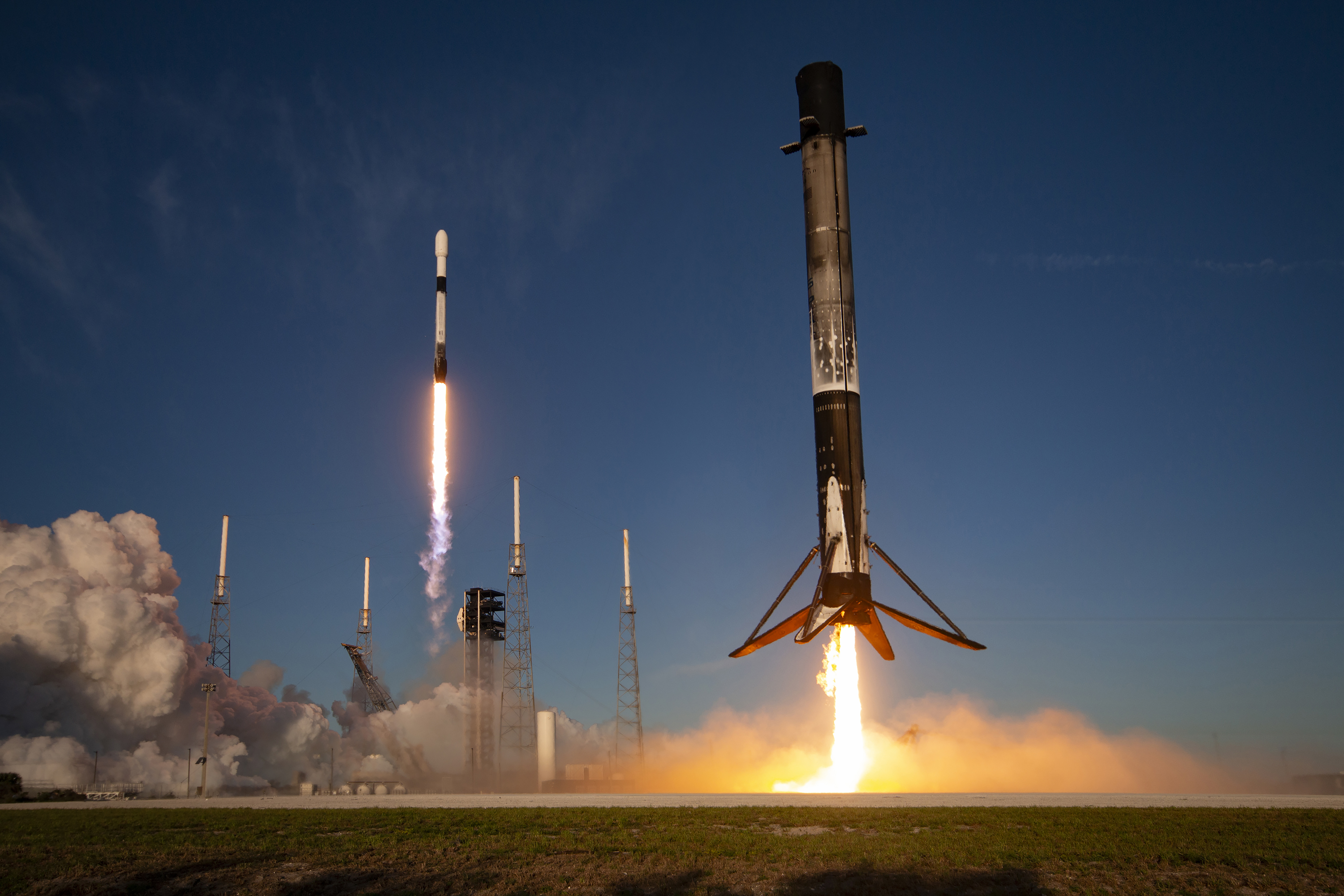

Blue Origin’s New Glenn heavy-lift orbital rocket has successfully undergone a critical hot fire test of its seven BE-4 engines at Cape Canaveral Space Force Station. This 20-second static fire, conducted on Thursday, April 16, is a crucial final step before the rocket embarks on its third mission, designated NG-3, with a launch window opening as early as Sunday, April 19.
The upcoming NG-3 mission is particularly noteworthy as it will mark the first time a New Glenn first-stage booster will be reused. The booster, named 'Never Tell Me the Odds,' previously flew and successfully landed during the NG-2 mission in late 2025, which delivered NASA's ESCAPADE probes towards Mars.
The New Glenn Launch Vehicle
New Glenn is a formidable two-stage rocket, standing at more than 320 feet (98 meters) tall with a 23-foot (7-meter) diameter. Its first stage is powered by seven Blue Origin BE-4 engines, which use liquefied natural gas (LNG) and liquid oxygen (LOX) as propellants. The second stage, sharing the same 7-meter diameter, is propelled by two vacuum-optimized BE-3U engines, which use liquid hydrogen and liquid oxygen.
Each New Glenn first stage is designed to be reusable for a minimum of 25 flights, a testament to Blue Origin's commitment to reusability.
The first stage is designed for vertical landings, a technology Blue Origin honed with its New Shepard suborbital vehicle. The rocket boasts a significant payload capacity, capable of sending 45,000 kg to Low Earth Orbit (LEO) and 13,600 kg to Geostationary Transfer Orbit (GTO).

Engine Upgrades and Reusability Enhancements
For the NG-3 mission, while the booster itself is a re-flight, the seven BE-4 engines have been replaced. Blue Origin CEO Dave Limp stated that this decision was made to test out several upgrades, including a new thermal protection system on one of the engine nozzles.
These engine upgrades are part of a broader series of enhancements announced by Blue Origin in November 2025, aimed at boosting performance, increasing launch cadence, and enhancing reliability. The total thrust for the seven BE-4 booster engines is increasing from 3.9 million lbf to 4.5 million lbf, with individual engines demonstrating 640,000 lbf of thrust at sea level. The two BE-3U upper stage engines are also seeing a thrust increase from 320,000 lbf to 400,000 lbf.
Great question! With our first refurbished booster we elected to replace all seven engines and test out a few upgrades including a thermal protection system on one of the engine nozzles. We plan to use the engines we flew for NG-2 on future flights.
— Dave Limp (@davill) April 13, 2026
The NG-3 Mission: AST SpaceMobile's BlueBird-7
The primary payload for the NG-3 mission is AST SpaceMobile's BlueBird-7 satellite. This Block 2 BlueBird satellite is designed to deliver significantly increased bandwidth capacity, up to ten times that of its predecessors, with peak data speeds of 120 megabits per second per coverage cell.
These satellites are notable for their immense communication arrays, spanning up to 2,400 square feet, making them among the largest commercially deployed satellites in Low Earth Orbit. The goal of AST SpaceMobile is to provide direct-to-cellphone broadband connectivity globally, bypassing the need for specialized satellite phones.
The successful re-flight of a New Glenn booster on NG-3 is a pivotal moment for Blue Origin, demonstrating their progress in achieving operational reusability and establishing their competitive position in the commercial launch market against established players like SpaceX.