


For the First Time in a Generation, Humans Are Heading Beyond Earth Orbit
- 4 minutes ago
- 6 min read

The First Human Mission Beyond Earth Orbit in Over 50 Years
With launch now just days away, NASA is preparing to send astronauts beyond low Earth orbit for the first time since the Apollo 17 mission in December 1972.
The mission, known as Artemis II, is the second flight in NASA’s Artemis program and the first to carry a crew. It represents the next step in rebuilding the capability to send humans to the Moon, this time with the goal of staying and expanding deeper into the solar system.
At the center of the mission are two key systems:
The Space Launch System (SLS), the most powerful rocket NASA has ever built
The Orion spacecraft, designed to carry astronauts safely into deep space and back
Together, these systems form the backbone of NASA’s plan to return humans to the lunar surface and eventually move toward Mars.
What Artemis II Actually Does
For someone new to spaceflight, Artemis II can be thought of as a full systems test—with people on board.
The mission does not land on the Moon. Instead, it sends astronauts on a multi-day journey around it and back to Earth. This approach allows NASA to verify that every system required for human deep space travel works under real conditions.
The flight follows what is called a free-return trajectory. This is a carefully designed path that uses the Moon’s gravity to bend the spacecraft’s path back toward Earth. If something goes wrong with propulsion, the spacecraft can still return home without needing major course corrections.
Step-by-step mission flow:
Launch from Kennedy Space Center
The SLS rocket lifts Orion and its crew into space.
Earth Orbit Checkout
Orion spends a short time in orbit while astronauts verify systems, navigation, and communications.
Translunar Injection (TLI)
The rocket’s upper stage performs a burn that sends Orion toward the Moon.
Coast to the Moon
The spacecraft travels for several days, moving farther from Earth than any human has gone since Apollo.
Lunar Flyby
Orion passes behind the Moon and uses its gravity to change direction.
Return to Earth
The spacecraft heads back on a natural return path.
Reentry and Splashdown
Orion reenters Earth’s atmosphere at extremely high speeds before landing in the ocean.
This mission verifies navigation, life support, propulsion, communications, and the spacecraft’s ability to survive reentry heating from deep space velocities.
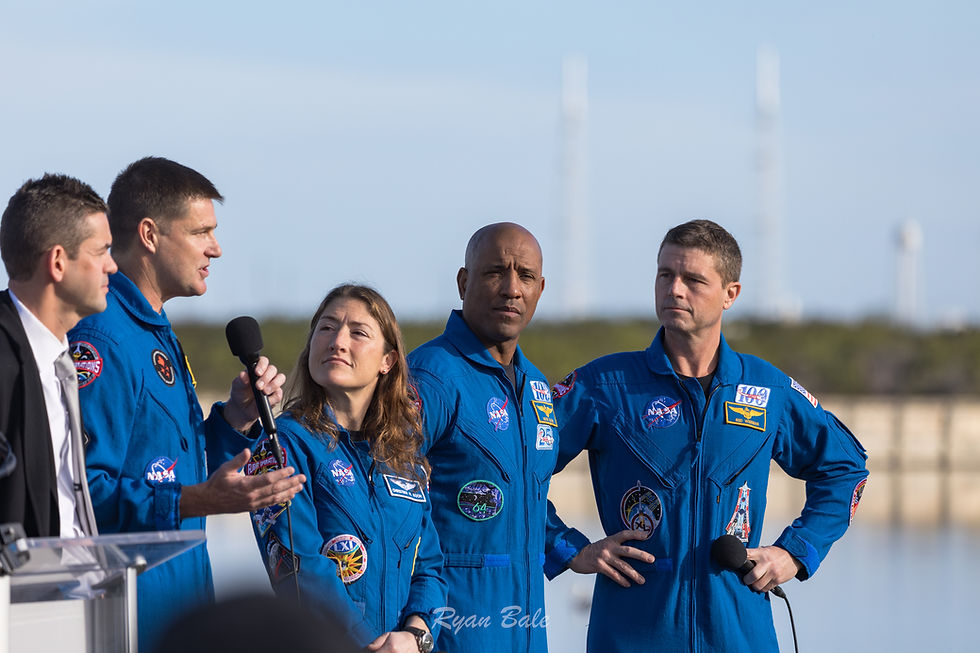
The Artemis II Crew
Artemis II carries four astronauts, each with a defined role during the mission.
Reid Wiseman – Commander
Responsible for the overall mission, decision-making, and crew safety. Previously commanded the International Space Station.
Victor Glover – Pilot
Assists with spacecraft control, trajectory monitoring, and critical flight operations.
Christina Koch – Mission Specialist
Manages onboard systems and mission objectives, with experience from long-duration spaceflight.
Jeremy Hansen – Mission Specialist (CSA)
Represents Canada and supports mission operations and scientific objectives.
This will be the first time a woman and a non-American astronaut travel beyond low Earth orbit.

Understanding the Rocket: Why SLS Is Different
The Space Launch System is built for one purpose: sending heavy payloads and crews beyond Earth orbit.
At a basic level, rockets work by pushing mass downward at high speed to generate thrust upward. To send astronauts to the Moon, that thrust must be sustained long enough to reach orbit and then accelerate even further to escape Earth’s gravity.
SLS is designed to handle both of those phases.
Core Components
Core Stage (the main body of the rocket)
Stores liquid hydrogen and liquid oxygen, which feed the engines. These propellants are cooled to extremely low temperatures to remain liquid.
Four RS-25 Engines
Mounted at the base of the core stage, these engines burn hydrogen and oxygen to produce high-efficiency thrust. They are the same engines used on the Space Shuttle, upgraded for higher performance.
Solid Rocket Boosters (SRBs)
Two large boosters attached to the sides of the rocket provide the majority of thrust during the first two minutes of flight. They burn solid fuel and cannot be shut down once ignited.
Interim Cryogenic Propulsion Stage (ICPS)
The upper stage that performs the critical burn to send Orion toward the Moon after reaching orbit.
What Happens During Launch
At liftoff, the RS-25 engines ignite first, ramping up to full power. Seconds later, the solid rocket boosters ignite, committing the rocket to flight.
First 2 minutes: Boosters provide most of the thrust
~2 minutes: Boosters separate and fall away
~8 minutes: Core stage engines shut down (main engine cutoff)
Shortly after: Upper stage takes over to place Orion into orbit
After reaching orbit, the upper stage performs the translunar injection burn, accelerating Orion to speeds of roughly 25,000 mph to begin its journey to the Moon.
Why SLS Is Required
Reaching low Earth orbit is one challenge. Leaving Earth entirely is another.
To send a crewed spacecraft toward the Moon, the rocket must:
Carry large amounts of fuel
Support heavy life-support systems
Deliver enough energy to escape Earth’s gravity
SLS is built to handle these requirements in a single launch, eliminating the need for on-orbit assembly or refueling for this mission profile.
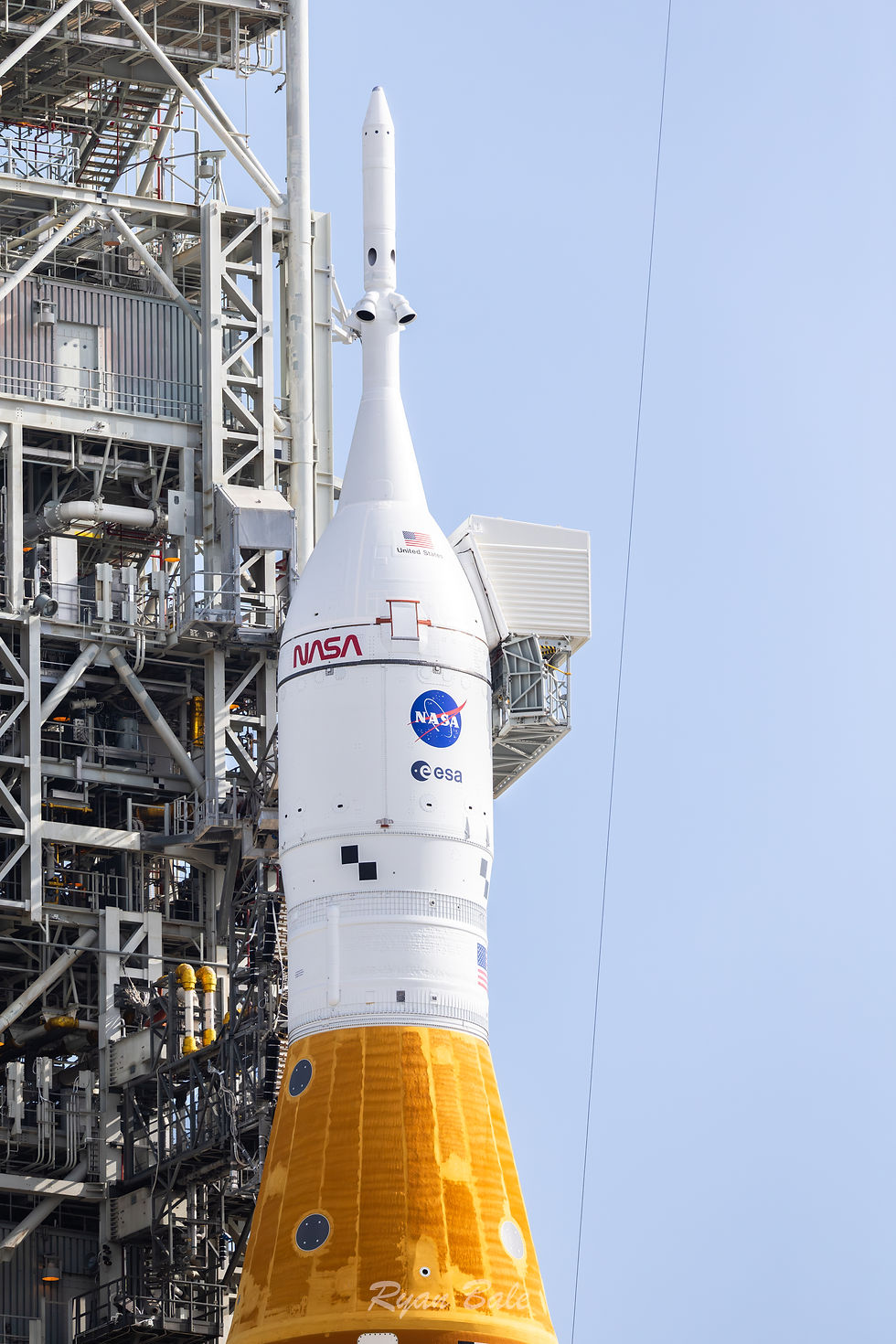
Inside Orion: The Spacecraft Carrying the Crew
Orion is the spacecraft that keeps the crew alive from launch through splashdown. It is made up of two main sections:
Crew Module – where the astronauts live and work
Service Module – provides power, propulsion, oxygen, and water
Together, they function as a self-contained system capable of operating far beyond Earth.
Inside the Crew Module
The crew module is a pressurized capsule designed to support four astronauts for multiple days.
Inside, astronauts have:
Flight displays and controls for navigation and system monitoring
Seats designed to absorb launch and landing forces
Life support systems, including oxygen supply and carbon dioxide removal
Storage for food, water, and mission equipment
The spacecraft operates largely through automated systems, but astronauts can take manual control if needed.
The Service Module
Attached behind the crew module, the service module is critical for mission success.
It provides:
Main engine and maneuvering thrusters for trajectory corrections
Solar arrays that generate electrical power
Thermal control systems to regulate temperature
Consumables like air and water
This module is provided by the European Space Agency, making Orion an international spacecraft.
Reentry and Heat Protection
Returning from the Moon is one of the most extreme phases of the mission.
Orion will reenter Earth’s atmosphere at speeds near 25,000 mph, generating temperatures approaching 5,000°F. To survive this, it uses a large ablative heat shield that gradually burns away, carrying heat away from the spacecraft.
After reentry:
Parachutes deploy in sequence
The capsule slows dramatically
Orion splashes down in the ocean for recovery
Why Orion Is Different
Spacecraft designed for low Earth orbit, like those used for the International Space Station, remain within Earth’s protective magnetic field.
Orion is built to go beyond it.
That means:
Increased exposure to radiation
Longer communication delays
Greater need for autonomous operation
Every system onboard is designed with those conditions in mind, making Orion NASA’s primary vehicle for deep space human exploration.
Why This Mission Matters
Artemis II provides the first real test of sending humans into deep space using a completely new system.
It allows NASA to:
Validate crew safety beyond low Earth orbit
Test spacecraft systems under real mission conditions
Refine procedures for future lunar missions
Demonstrate long-distance communication and navigation
The mission also represents a shift toward sustained exploration rather than short-term missions.

What Comes Next: Artemis III and the Path Forward
Following Artemis II, NASA plans to move to Artemis III, which aims to land astronauts near the Moon’s south pole.
Future missions will introduce new systems:
Human landing spacecraft developed through commercial partnerships
Surface operations designed for long-term presence
Infrastructure in lunar orbit
Beyond the Moon, these missions build toward human exploration of Mars.
A Return That Builds Toward the Future
Artemis II reconnects human spaceflight with deep space exploration. The mission carries forward lessons from Apollo while introducing systems designed for long-term use.
For many watching, this will be the first time seeing astronauts leave Earth orbit in their lifetime.
The outcome of this mission will determine how quickly humans return to the lunar surface—and how soon they begin moving even farther outward.
Comments