
HASTE | Bubbles
Sub-orbital launch under Rocket Lab’s Hypersonic Accelerator Suborbital Test Electron (HASTE) program, details TBD.
Launch Vehicle
Electron
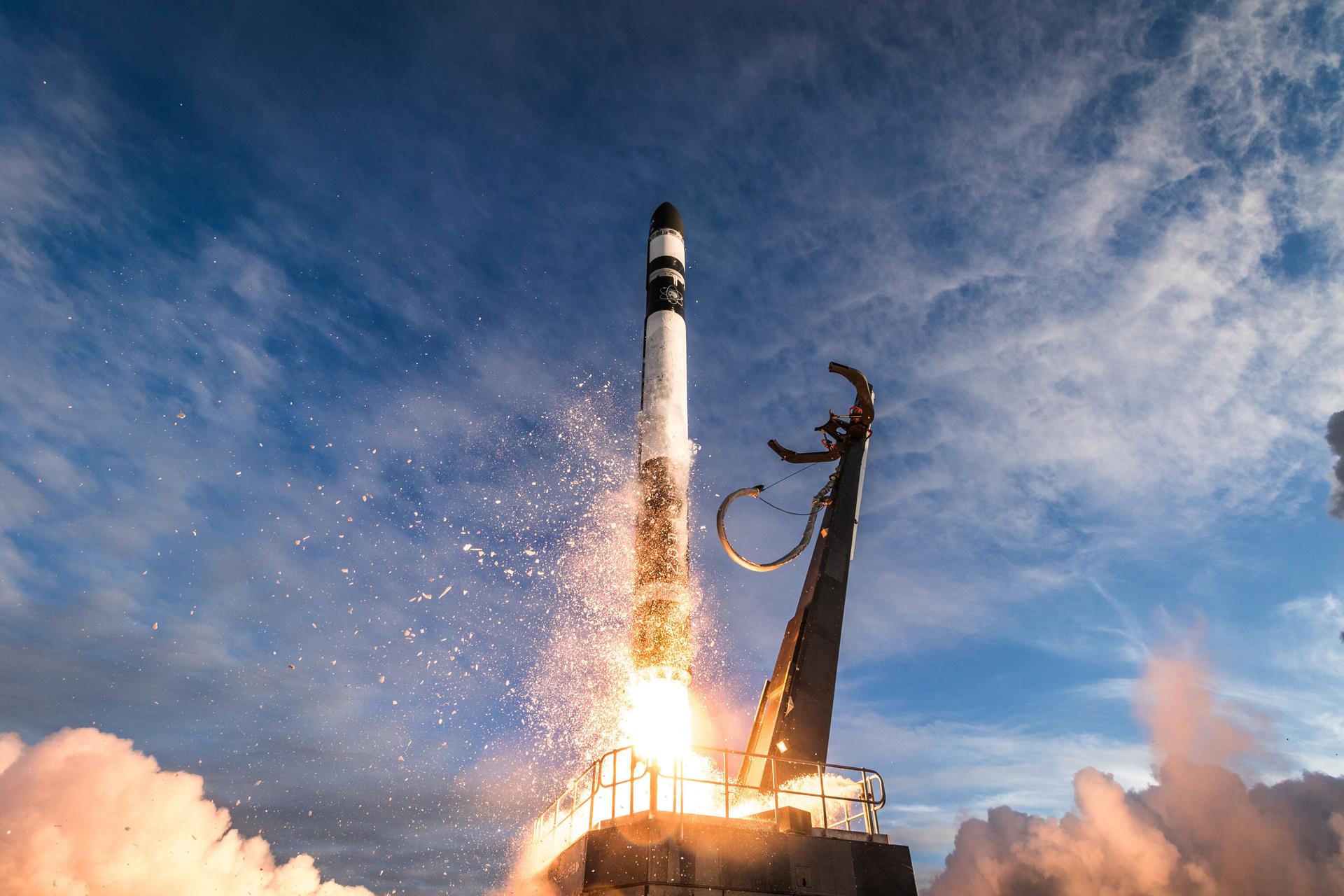
Electron is Rocket Lab's small orbital launch vehicle and one of the most innovative rockets flying today. Its Rutherford engines are almost entirely 3D-printed and use an electric turbopump driven by lithium-polymer batteries — eliminating the gas generator found on conventional engines. Rocket Lab began recovering and reusing first-stage boosters in 2022, making Electron the first small-class rocket with an active reuse programme.
18 m (59 ft)
1.2 m (3.9 ft)
300 kg (to 500 km SSO)
2
January 21, 2018 (first successful orbital flight; first attempt May 25, 2017)
Engines
9× Rutherford (first stage), 1× Rutherford Vacuum (second stage)
Propellant
RP-1 (kerosene) / Liquid Oxygen
Reusable
YesNotable
- Rutherford engines are the first 3D-printed, flight-proven orbital rocket engines
- Electric turbopump — driven by batteries — replaces the traditional gas generator cycle
- First stage recovered via helicopter capture over the ocean (first successful catch: May 2, 2022)
- 50+ orbital flights, serving commercial, NASA, DARPA, and NRO customers
T-Minus
Launch Window
Window not open
Open
8:00 PM EDT
Target
8:00 PM EDT
Close
1:00 AM EDT
7 days out
Weather forecasts beyond 4 days are too unreliable for launch planning. Check back closer to launch time.
No livestream link available yet
Rocket Lab Launch Complex 2 (Launch Area 0 C), Wallops Flight Facility, Virginia
Launch data via TheSpaceDevs Launch Library. Weather estimates via Open-Meteo using vehicle-specific commit criteria. Always verify with the launch provider.